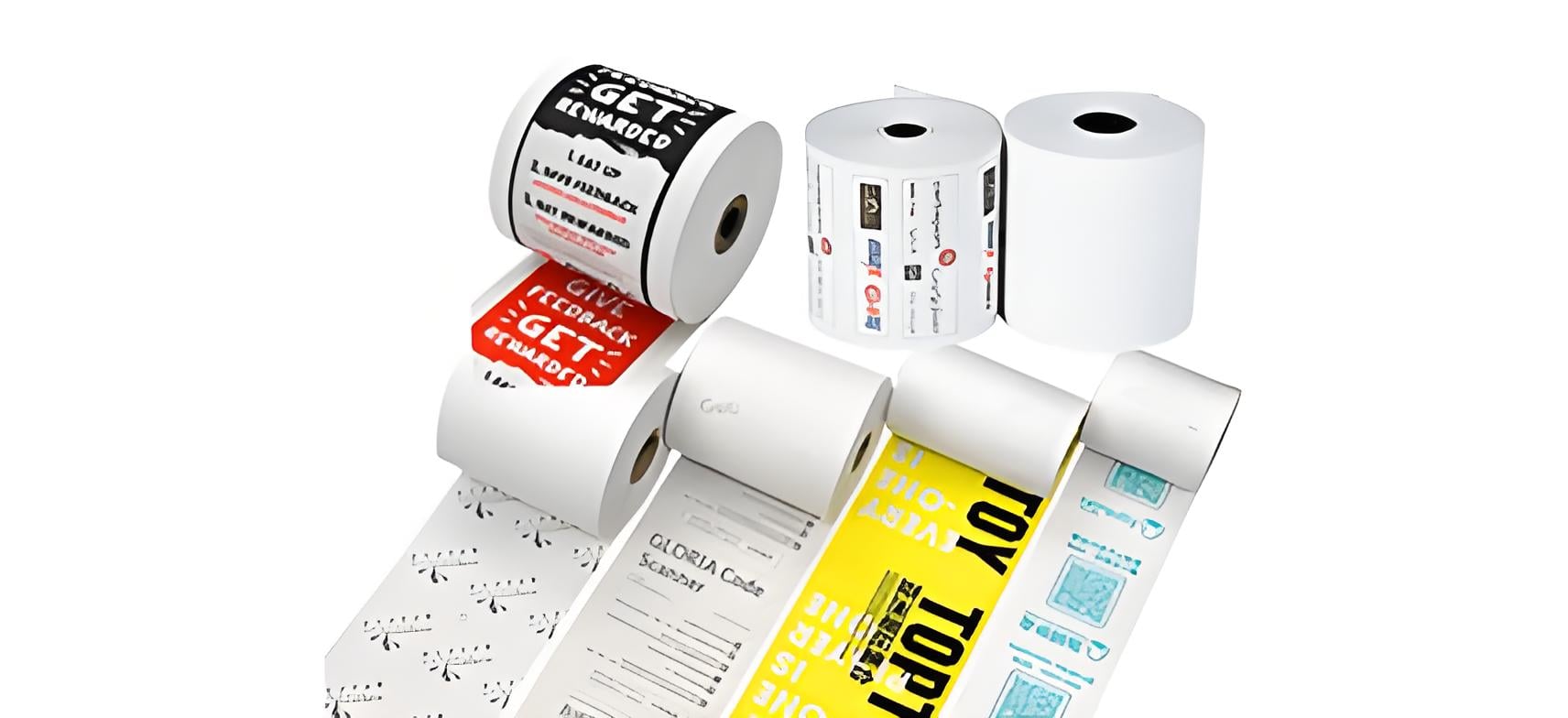
Custom printing on thermal paper rolls is one of the most cost-effective ways for businesses to reinforce brand identity, deliver targeted promotions, and generate additional revenue from every customer transaction. Whether you want your logo on every receipt, coupon offers on the back, or QR codes linking to loyalty programs, this guide covers everything B2B buyers need to know about custom thermal paper roll printing.
What Is Custom Thermal Paper Roll Printing?
Custom thermal paper roll printing refers to pre-printing graphics, text, or promotional content onto thermal paper rolls before they are shipped to the end user. Unlike printing at the point of sale (which uses the thermal printer itself), custom pre-printing is done at the factory using flexographic or offset printing presses, allowing for full-color designs, photographic images, and complex layouts that standard thermal printers cannot produce.
There are two main types of custom printing: front-side printing and back-side (back print) printing. Front-side printing adds a pre-printed header, footer, or background to the receipt area. Back-side printing uses the reverse side of the roll — which is not thermally coated — to carry advertising, coupons, loyalty program information, or legal disclosures.
Front Print vs Back Print: Which Is Right for You?
Front-side printing is ideal for adding a consistent brand header to every receipt — your logo, store address, website, and tagline. Because the front side is thermally coated, only the uncoated areas can be pre-printed; the thermal printing area must remain clear for the POS system to print transaction details. This limits front-side printing to headers, footers, and borders.
Back-side printing offers more layout space for approved promotional coupons, QR codes, loyalty information, seasonal offers, or brand storytelling. Campaign results depend on the offer, audience, distribution, placement, and redemption workflow, so performance should be measured with campaign-specific codes or links.
For maximum impact, many brands combine both: a front-side logo header with a full back-side promotional design. This approach is particularly popular in food service, retail, and hospitality.
Technical Requirements for Custom Printing
Artwork for custom thermal paper printing should be supplied as vector files (AI, EPS, or PDF) at the correct dimensions. The print area dimensions depend on the roll width — for an 80mm roll, the printable width is typically 76-78mm after edge margins. Your supplier will provide a print template showing the exact printable area, bleed zones, and any restricted areas.
Color printing on thermal paper uses water-based flexographic inks that are compatible with the thermal coating. Standard process colors (CMYK) are available, as are Pantone spot colors for precise brand color matching. Note that very dark or dense ink coverage on the front side can slightly reduce thermal sensitivity in those areas — your supplier should test print samples before production.
For QR codes and barcodes, ensure the minimum quiet zone (white space around the code) is maintained, and test scan reliability before approving production. QR codes should be at least 20mm x 20mm for reliable scanning at typical reading distances.
Minimum Order Quantities and Pricing
Custom printed thermal paper rolls usually require an order quantity that supports the selected paper, plate setup, print side, colors, dimensions, and packing. The quotation should state the current MOQ after these fields are reviewed rather than relying on a universal threshold.
Pricing depends on roll dimensions, paper grade, artwork coverage, number of colors, plate or tooling needs, packing, and quantity. Compare the approved custom specification with the equivalent plain-roll specification in the same quotation.
The production schedule is confirmed after material, artwork, proof or sample approval, current capacity, packing, and shipping requirements are reviewed. Seasonal programs should include approval and transport buffers in the requested delivery plan.
How to Get Started: The Custom Print Process
The custom print process follows five controlled stages: (1) submit artwork or a brief; (2) confirm the print template and digital proof schedule; (3) approve the proof or request revisions; (4) review a physical production-intent sample when included in the quotation; and (5) release production and shipment after approvals. Plate-making and press setup are defined in the project quotation.
If artwork support is required, submit the brand guidelines, approved assets, required copy, and campaign objective. Design scope, fees, revisions, and deliverables are confirmed before work begins.
Request a sample plan for the chosen roll specification before a custom print order. Sample type, quantity, fee, production method, courier route, and schedule are confirmed by SKU and destination so printer fit can be checked before bulk printing.
Conclusion
Custom receipt printing can add approved brand, disclosure, or campaign content to each receipt. Results and economics depend on the artwork, offer, audience, quantity, and redemption workflow. Request a print template, project quote, and sample plan for the selected roll specification.
Key Takeaways
- Measure campaign performance with offer-specific QR codes, links, or redemption codes
- MOQ is confirmed from paper grade, roll size, print side, colors, tooling, packing, and quantity
- Supply artwork as vector files (AI/EPS/PDF) — Zhixin Paper provides print templates
- QR codes should be minimum 20mm x 20mm for reliable scanning
- Production schedule is confirmed after specification, artwork, sample, capacity, and packing review
Related Industry Pages
- Retail & POS: Plan branded receipts around print side, artwork, QR area, proof approval, and packing.
- Events & Hospitality: Connect campaign artwork and sponsor content to venue printer and ticket requirements.
- Banking & Finance: Control disclosure or branded back print through device fit, revision, and proof approval.
Frequently Asked Questions
What should buyers confirm before ordering how to print your logo on thermal paper rolls: complete guide?
Confirm the exact application, printer or terminal fit, destination market, required documents, and approval process before issuing the purchase order for this education project.
Is the article summary enough for supplier approval?
No. Step-by-step guide to custom logo printing on thermal paper rolls, including back print options, coupon printing, QR codes, and MOQ requirements for B2B buyers. Buyers should still request grade-specific documents, test evidence, and representative samples before approving bulk production.
Which internal pages should I review next?
Review the relevant industry page, compare product specifications, and use the contact or quote forms to align the final requirement set with the quoted material.
Next Step
If you need support on specifications, documentation scope, or sample planning, continue with one of these internal pages:
- Request Samples to validate material, dimensions, and printer fit.
- Get a Quote to align the RFQ with width, OD, core, chemistry, packing, and destination requirements.
- Contact Us for project-specific technical review.
Product fit
Continue with the matching specification.
Compare construction, application fit, and the information needed for a representative sample or quotation.
Related Posts
Send Your Inquiry Today
Tell us the product, dimensions, material, quantity, and destination. We will review the right specification before quoting.
Submit your requirement