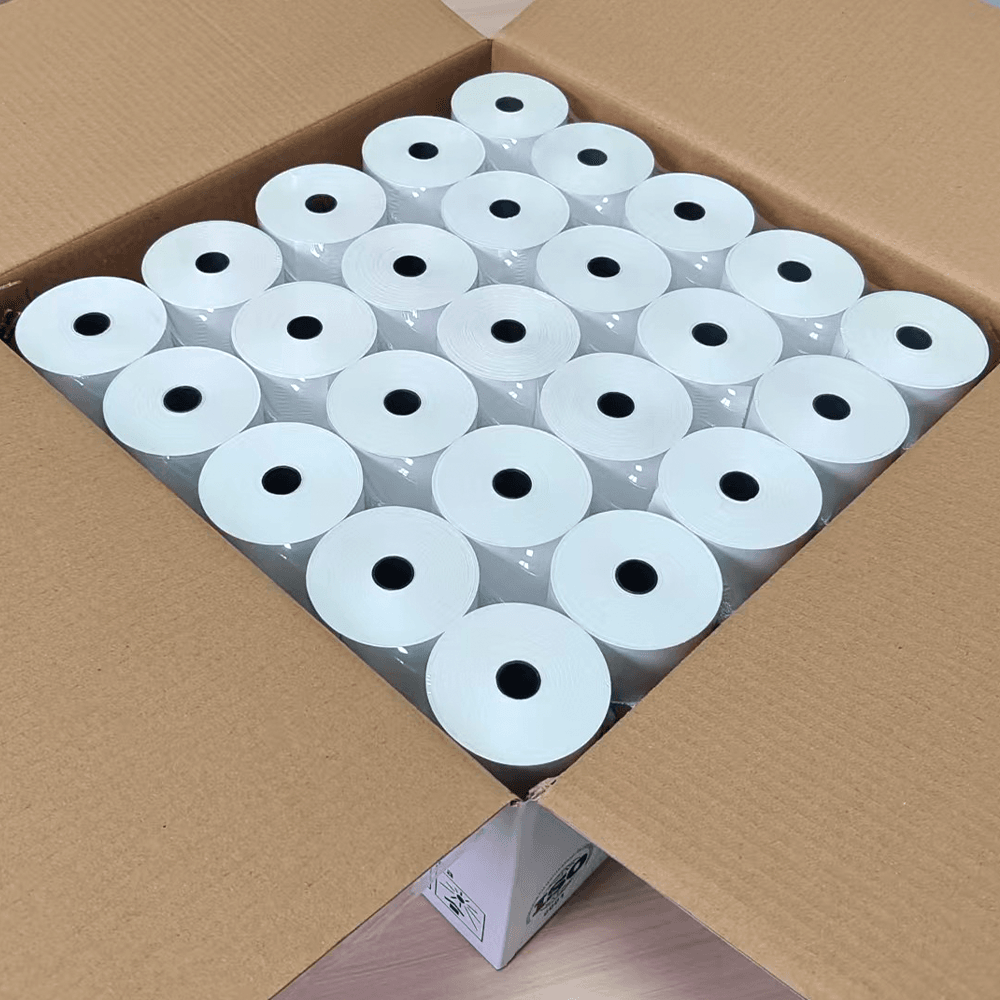
If you want faster and cleaner pricing on receipt rolls, send suppliers a device-based RFQ instead of a one-line request for "POS paper". Most quote delays come from missing width, outer diameter, core size, winding direction, carton details, or destination data. The checklist below helps US and Canada buyers turn an existing roll sample or printer name into a specification package that a supplier can price without guessing.
Lock the commercial spec before you ask for price
Start with the roll geometry that the printer can actually accept. Buyers often know that they need "80 mm paper", but that is only one line in the order. A commercial RFQ should also show how the roll is packed, how many units move per store or per month, and whether the order is for standard white paper or a custom program.
Use a short spec table in the RFQ. A supplier should be able to read it and quote without asking basic fit questions again.
| Common use case | Roll width | Outer diameter | Core ID | Typical note |
|---|---|---|---|---|
| Grocery and restaurant POS | 80 x 80 mm | 80 mm | 12.7 mm or 18 mm | High daily throughput |
| Counter printer with smaller compartment | 80 x 70 mm | 70 mm | 12.7 mm | Same width, lower capacity |
| Payment terminal | 57 x 40 mm | 40 mm | 12.7 mm | Portable or compact devices |
| Kiosk or queue printer | 80 x 150 mm | 150 mm | 25.4 mm | Check compartment clearance first |
Confirm these points before you request a quote:
- Measure the current roll width, OD, and core ID from a live sample.
- Record the printable side and winding direction.
- State whether you need plain rolls, warning print, or private-label print.
- Specify estimated annual volume in rolls, cartons, or pallets.
- Tell the supplier whether mixed-SKU cartons are allowed.
If your team is still comparing formats, send the supplier one "must-fit" option and one "cost-down" option. That gives you a usable pricing range without losing control of the project.
Verify the printer and store environment
Printer fit is not just a paper question. It is a device question. Ask operations for the exact printer model, terminal model, or compartment drawing. If the order supports multiple chains, record which stores use which machine. A 3 mm OD mistake can turn into a receiving problem across hundreds of lanes.
For each device, verify:
- Printer or terminal model number
- Maximum roll width and maximum OD
- Core size or spindle requirement
- Top-coated or standard surface preference
- Paper exit direction and winding
- Sensor type if the device is sensitive to paper marks or roll tension
Buyers should also ask what "acceptance" means on site. Some teams only need the roll to fit. Others need quiet unwind, sharp image density, low dust, and no early paper-end complaints. Put those criteria into the RFQ. A useful sample plan is 2 to 3 rolls per device model, tested over at least one normal trading shift.
If the device is unknown, do not guess from memory. Request a photo of the printer label, a photo of the loaded roll, and three measurements: width, OD, and core ID. That is enough to start a controlled quote. You can compare the result against the supplier's thermal paper rolls page and send the final purchase brief through the quote form.
Review paper performance, packing, and delivery details
Once fit is confirmed, move to the commercial details that affect landed cost and receiving speed. Buyers should ask the supplier to match the quoted paper grade to the exact roll spec, not just to a generic family name. If your internal policy asks for a specific chemistry declaration, request that document against the exact grade name used in the quote.
Useful operating details include:
- Image life target, such as 2 years for routine retail records or longer for archived documents
- Storage range, such as 5 to 30 deg C and 45% to 65% relative humidity before use
- Shrink-wrap style, inner pack count, and cartons per pallet
- Carton label fields, including SKU, roll size, roll count, lot number, and destination code
- Delivery terms, delivery window, and whether partial shipments are allowed
Ask for a packing example, not just a verbal answer. A buyer who orders 50,000 rolls for two countries needs to know if the load will arrive as 50-roll cartons, 100-roll cartons, or mixed pallets with separate lane labels. Receiving teams care about that long before finance reviews the invoice.
It is also worth deciding how repeat orders will be controlled. Record a simple order code that ties together roll size, paper grade, core, winding, carton count, and carton mark. If the code changes, the buyer should re-check the sample. That rule avoids quiet spec drift on later replenishment.
Build a short sample and approval workflow
The fastest RFQ is still risky if nobody owns approval. Put a buyer-side workflow in writing:
- Confirm device list and target roll sizes.
- Request quote with annual volume, carton rules, and destination.
- Request samples for each device group.
- Test fit, image density, unwind, and basic handling.
- Approve the exact grade name and packing format.
- Release production only after the sample result is recorded.
This does not need a long SOP. A one-page approval note is enough. What matters is that the commercial team, the warehouse, and the store operations team are all approving the same SKU.
If you also need private-label work later, route the inquiry through the contact page or link the RFQ to a follow-up custom print discussion after the standard roll is approved.
Frequently Asked Questions
What if the buyer only has an old roll sample and no printer model?
Measure the sample first. Record width, OD, core ID, and printable side. Then ask the site team for photos of the printer label and the loaded paper path. That gives enough data for a first quote and a controlled sample round.
Should one RFQ include multiple roll sizes?
Yes, if the project really covers multiple device groups. Keep each size on its own line with its own annual volume, carton rule, and destination note. Do not merge different sizes into one vague total.
When should a buyer reject a quote and ask for a revision?
Ask for a revision when the quote does not show the exact roll geometry, when the core size is missing, when carton quantities are unclear, or when the supplier references a paper grade without matching it to the quoted SKU.
How many samples are enough before first production?
For a normal retail project, buyers usually learn a lot from 2 to 3 rolls per device model. If the program covers many store types, run at least one short test per model before the first mass order.
Related Posts
Send Your Inquiry Today
Tell us the product, dimensions, material, quantity, and destination. We will review the right specification before quoting.
Submit your requirement